What Is Clean Core?
SAP’s Clean Core Architecture is a strategic framework for keeping S/4HANA systems simple, cloud-ready, and future-proof. The idea is straightforward: adopt SAP standard processes wherever possible, move custom innovations to SAP BTP, and maintain a core that can absorb upgrades and new capabilities without disruption.
Traditional SAP landscapes accumulate decades of custom code, fragmented integrations, and technical debt – making even routine upgrades expensive and risky. Clean Core addresses this by delivering faster upgrades, simplified operations, better data quality for AI and analytics, and a lower total cost of ownership.
The Five Pillars of Clean Core
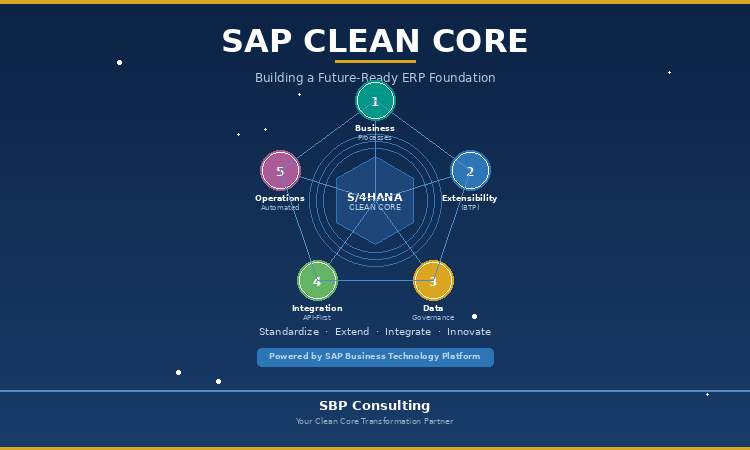
SAP’s strategy rests on five interconnected pillars. Each plays a specific role in ensuring long-term stability and cloud readiness.
1. Business Processes – Fit-to-Standard First
Organizations should adopt SAP’s standard processes as the baseline and only extend them where a process genuinely differentiates the business. Outdated or redundant workflows should be eliminated. SAP Signavio and Cloud ALM provide the tooling to discover, manage, and govern process landscapes. Standard processes reduce complexity, shorten project timelines, and keep the system compatible with SAP’s innovation roadmap.
2. Extensibility – Decouple from the Core
Business-specific innovation should happen without modifying SAP standard code. SAP provides two extensibility paths:
- On-Stack: Key User Extensibility for custom fields and UI changes; ABAP Cloud (Developer Extensibility) for modern development using released APIs, CDS views, and BAdIs.
- Side-by-Side (SAP BTP): SAP CAP for cloud-native services, ABAP Cloud on BTP, SAP Build Apps for low-code, Integration Suite for API/event-driven integration, and AI Core & Joule for intelligent automation.
SAP classifies every extension into one of the four Clean Core levels:
| Level | Description |
| A | Cleanest — uses only released SAP APIs, ABAP Cloud, SAP Build, BTP-first development |
| B | Uses classic stable SAP APIs (BAPIs, established frameworks) |
| C | Uses SAP internal objects (conditionally clean; higher upgrade risk) |
| D | Not clean — modifications, restricted objects, no-API items |
The goal is to target Level A wherever possible and systematically eliminate Level D extensions.
3. Data – Governed, Clean, Consistent
Data quality is one of the biggest blockers in transformation programs. Organizations must maintain a unified data model aligned with SAP standards, avoid silos and duplicate objects, and implement strong governance for master data, transactional data, and metadata. Clean, well-governed data increases system reliability, reduces errors, and enables AI and predictive features across the Business Suite and BTP.
4. Integration – API-First, Event-Driven
Clean Core demands modular, loosely coupled integrations that do not entangle ERP with third-party systems. Use released SAP APIs from the Business Accelerator Hub, prefer event-driven architectures with SAP Event Mesh, and standardize patterns through Integration Suite. Avoid point-to-point custom interfaces — they create significant technical debt and break during upgrades.
5. Operations – Efficient and Automated
SAP Cloud ALM provides monitoring, alerting, lifecycle governance, and KPI management. Organizations should enforce quality gates, automate readiness checks, minimize manual tasks, and continuously track clean-core KPIs such as clean code share, unused objects, and modifications. Efficient operations reduce downtime and keep the system ready for continuous innovation.
Common Challenges
Organizations pursuing Clean Core typically encounter resistance to change, the complexity of retiring legacy custom code, the need for strong governance frameworks, heavy cross-functional involvement, industry-specific compliance requirements, and integration challenges with older systems. Effective change management and clear decision frameworks are essential for overcoming these hurdles.
The Role of SAP BTP
SAP BTP is the innovation engine behind Clean Core. It supports all five pillars through side-by-side extensibility, API and event-driven integration, workflow and process automation, data-to-value services, AI Core and Joule for intelligent automation, and both low-code and pro-code development options. With BTP, S/4HANA remains a stable digital core while innovation moves to a flexible, scalable cloud platform.
Best Practices
- Standardize first: Analyze the current process landscape, remove redundant customizations, and align with SAP standard capabilities.
- Extend on BTP: Build and integrate new applications without touching the core using CAP, ABAP Cloud, Integration Suite, and automation tools.
- Stay informed: Track SAP innovations, reference architectures, Activate Methodology updates, and extensibility guidelines.
- Collaborate with partners: Leverage specialized expertise for complex transitions and follow SAP’s best-practice tooling.
Key SAP Tools
- SAP BTP – extensibility, integration, and automation platform
- SAP Signavio – business process intelligence and mining
- SAP Datasphere – data governance and analytics
- Custom Code Migration App – identifies and retires unused code
- SAP Activate Methodology – structured implementation framework
- S/4HANA Extensibility Guide – clean extension best practices
How SBP Can Help
SBP consultants guide customers through every phase of the Clean Core journey with a structured, outcome-driven approach:
- Assessing the current SAP landscape – custom code, integrations, and extensibility – to identify gaps, risks, and opportunities.
- Eliminating unnecessary customizations and guiding clients toward SAP-standard capabilities that reduce complexity.
- Proposing pragmatic roadmaps with clear recommendations, effort estimates, and business impact analysis.
- Driving sustainable extensibility with a BTP-first and ABAP Cloud approach aligned with SAP’s direction.
- Implementing Clean Core solutions using proven methods that ensure quality, stability, and minimal business disruption.
- Providing ongoing support and continuous optimization as SAP innovations evolve.
Clean Core expertise across all five pillars is a key SBP differentiator – helping customers build a stable, scalable, and cloud-ready ERP foundation that delivers lasting business value.
Takeaway
SAP Clean Core is more than a technical guideline – it’s a business strategy for long-term resilience. When all five pillars work together, business processes stay agile, extensions remain stable, data becomes reliable, integrations become modular, and operations become efficient.
With the right balance of standardization and innovation – and with SBP as your transformation partner – you can build a future-ready ERP landscape that supports continuous growth and modern digital business models.